Description
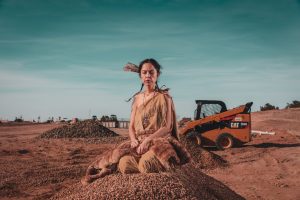
In This Could Be Us, Jeremy Dennis presents a powerful, haunting image of an anonymous Native figure carrying a woman, both turned away from the viewer, their faces obscured. The ambiguity of their identities invites the viewer to reflect on their own position within this narrative, suggesting that this scenario could involve anyone, even themselves, caught in the larger web of history and the ongoing struggle for land and justice. The title, This Could Be Us, evokes a range of interpretations, including the possibility of removal, displacement, and return — central tenets of the Land Back movement. The figures’ anonymity heightens the sense of universality and inclusion, as if the viewer, too, could be implicated in the ongoing process of reconciliation and restitution.
Dennis also subtly references the Indian Captivity narratives, a genre of literature popular in early American history that depicted the capture of white settlers by Indigenous peoples. These narratives were often framed within a religious context, where the captured settlers were seen as sinners, and their "rescue" was presented as a form of divine intervention, a pathway to redemption through God’s grace. By reworking this trope, Dennis critiques how such narratives have been used to justify the displacement and demonization of Indigenous peoples, while framing non-Western spirituality and Native culture as something to be feared, misunderstood, or "rescued" from. Through this reimagining, Dennis highlights the paradox of American desire for non-Western enlightenment — seeking to benefit from Native traditions and knowledge, while simultaneously undermining their sovereignty and existence. This Could Be Us challenges viewers to confront their complicity in the land’s history and its future, showing that the land return envisioned in the Land Back movement is not just an abstract political goal but a deeply personal reckoning that involves everyone.