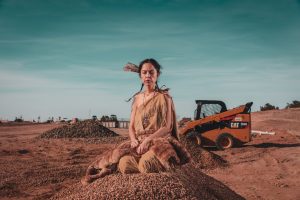
Pahquahkossit, 2016

$650.00

2016
Archival Inkjet Print
18 x 24 inches
Edition 2/10
Inventory 555

In stock

View in Room

SKU: 555 Categories: , Tag:

Description

Pahquahkossit, currently on view in
Living Conduit – Indigenous History and Present Day, South Ocean Gallery at South Nassau Unitarian Universalist Congregation, Freeport, NY, October 3, 2026 – November 21, 2026

Pahquahkossit is a recorded Indigenous name associated with Wading River on Long Island's North Shore. In testimony recorded in 1660, the Native elder Paucamp described a boundary reaching a wading creek and explained a related name, Pequaockeon, through the quahogs found there. Clams, water depth, and people's work were held together in the name. This was knowledge of a food place, carried by someone who knew the land.

Wading River's Native history continued beyond colonial land records. In the eighteenth century, Peter John Cuffee helped establish Native congregations at Wading River, Shinnecock, and Islip after beginning his work at Poospatuck. These communities could choose their own ministers. Their religious organization sustained Native and African American leadership and relationships within a changing colonial society.

The two histories belong together. Paucamp's testimony preserves environmental knowledge and Native authority to describe a boundary. Cuffee's work records people maintaining community life after settlers' documents increasingly claimed the land around them. Neither account supports the familiar story that Native people simply disappeared as towns grew. William Wallace Tooker later reproduced Paucamp's testimony in his 1911 place-name study, preserving an earlier Native explanation within a book written centuries afterward. Returning attention to the speaker changes the emphasis from an unusual word to a person's knowledge. Pahquahkossit connects the creek to quahog gathering, kinship, and the work of sustaining a community. Protecting the water is therefore connected with the possibility of continuing relationships to food and place, not only with preserving an attractive view.

View in Room

Approximate scale using a 72 inch sofa.

Artwork: 24 x 18 inches
Reference couch: 72 x 34 inches, a typical two-person sofa

Exhibited & Provenance

Exhibition history and artist-direct provenance.

Living Conduit – Indigenous History and Present Day

South Ocean Gallery at South Nassau Unitarian Universalist Congregation, Freeport, NY, October 3, 2026 - November 21, 2026

Encoded Landscapes 2026

March 30, 2026 - May 19, 2026

Description

Pahquahkossit, currently on view in
Living Conduit – Indigenous History and Present Day, South Ocean Gallery at South Nassau Unitarian Universalist Congregation, Freeport, NY, October 3, 2026 – November 21, 2026

Pahquahkossit is a recorded Indigenous name associated with Wading River on Long Island's North Shore. In testimony recorded in 1660, the Native elder Paucamp described a boundary reaching a wading creek and explained a related name, Pequaockeon, through the quahogs found there. Clams, water depth, and people's work were held together in the name. This was knowledge of a food place, carried by someone who knew the land.

Wading River's Native history continued beyond colonial land records. In the eighteenth century, Peter John Cuffee helped establish Native congregations at Wading River, Shinnecock, and Islip after beginning his work at Poospatuck. These communities could choose their own ministers. Their religious organization sustained Native and African American leadership and relationships within a changing colonial society.

The two histories belong together. Paucamp's testimony preserves environmental knowledge and Native authority to describe a boundary. Cuffee's work records people maintaining community life after settlers' documents increasingly claimed the land around them. Neither account supports the familiar story that Native people simply disappeared as towns grew. William Wallace Tooker later reproduced Paucamp's testimony in his 1911 place-name study, preserving an earlier Native explanation within a book written centuries afterward. Returning attention to the speaker changes the emphasis from an unusual word to a person's knowledge. Pahquahkossit connects the creek to quahog gathering, kinship, and the work of sustaining a community. Protecting the water is therefore connected with the possibility of continuing relationships to food and place, not only with preserving an attractive view.

Artwork Details
Title: Pahquahkossit
Year: 2016
Medium: Archival Inkjet Print
Size: 18 x 24 inches
Edition: 2/10

Shop

Browse print editions, framed works, mounted works, and books.

Back to all products

Cart