Description
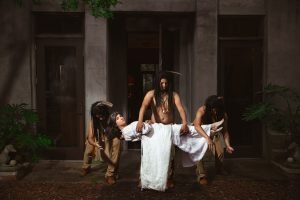
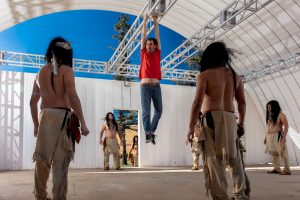
Cigar Indian confronts the paradox of Indigenous representation in American culture—how Native people can be simultaneously invisible and overexposed through stereotypes. In this staged photograph, a non-Native figure stands with a rifle, encircled by living Native people and a wooden “cigar store Indian” statue. Yet her gaze, and the direction of her aim, are fixed solely on the statue. She fails to see the living individuals surrounding her, perceiving only the caricature—a frozen, commercialized version of Indigeneity that has long occupied the American imagination.
Jeremy Dennis uses this surreal and unsettling composition to critique the persistence of these colonial images, which reduce Native identity to decorative symbols or mascots while erasing the complexity of contemporary Indigenous life. The act of aiming at the statue—rather than the people—reveals how society often interacts not with Native communities themselves, but with the distorted representations that stand in their place. The weapon becomes a metaphor for perception: what we choose to see, and what we erase, can both wound.
In Cigar Indian, Dennis turns the gaze back on the viewer, asking who benefits from these enduring stereotypes and what is lost when living Native voices are replaced by wooden ones. The photograph blurs the line between violence and vision, urging a reckoning with how deeply these images shape understanding, empathy, and the right to be seen.